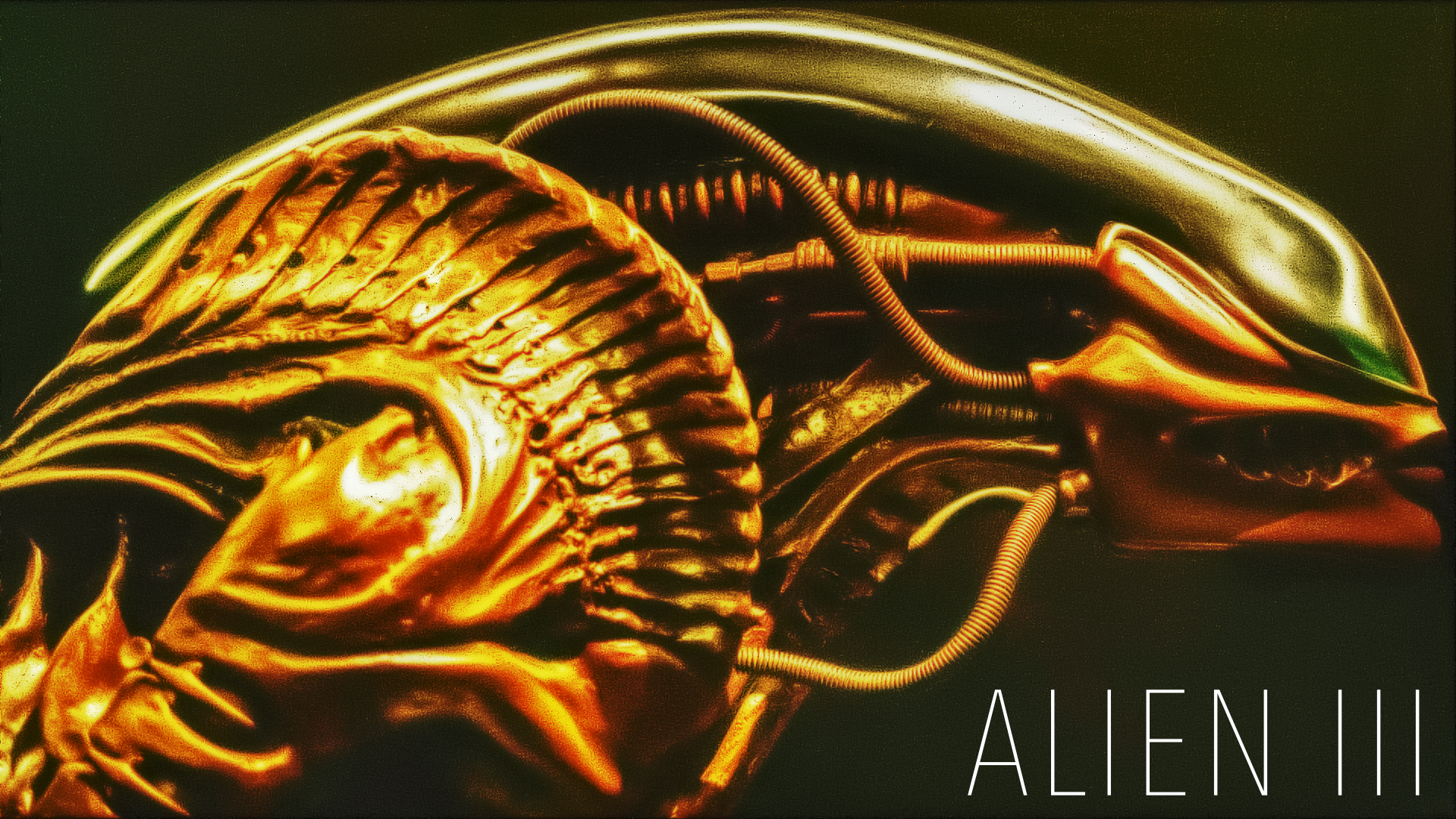
Alien III
1987 • 113 pages
FORMAT
Screenplay
WRITER
William Gibson
STORY BY
David Giler, Walter Hill
DRAFT TYPE
Revised First Draft
FRANCHISE
Alien
GENRE
Sci-Fi, Horror, Action
Anyone who knows anything about Alien³ knows that its making-of was a shitshow. The final product was a hatchet job (it still rocks, though. I will accept no Alien³ slander here), the product of a feud between a first time director with a vision and a studio eager to replicate the marketability of the smash-hit Aliens.
But, how did this project begin? You can find the whole story here, but in short; long-time Alien franchise producers Walter Hill and David Giler turned to renowned cyberpunk author William Gibson (Neuromancer, Point Zero) to write his first original screenplay, based on their story. In December, 1987, with a looming writers’ strike, Gibson turned in his first draft of Alien III, initially conceived as the first of a two-part conclusion to the series.
Ultimately, Hill said he found it “competent, yet underwhelming,” and wanted Gibson to work with then-attached director Renny Harlin (Deep Blue Sea, The Strangers Trilogy) on improvements, at which point Gibson dropped out. That said, Gibson’s script has seen a second life; being adapted into a novelization, an audio-drama, and even a comic book series.
While he would submit a second draft in 1988, I want to cover the first draft. This is because the first draft was the basis for the official novelization written by Pat Cadigan and published in 2021. That book was what inspired me to start writing novelizations of the unproduced scripts I collect, making this very much a full-circle moment.
Plot
After escaping the alien threat; Corporal Hicks, Bishop, Ripley, and Newt are in hypersleep aboard the Sulaco. Their ship flies into the airspace of the United Progressive Peoples (think a space version of the USSR), where Bishop’s bisected body is stolen after alien material is found within.
The Sulaco eventually docks at Anchorpoint, a US space station. After a skirmish occurs with aliens hiding inside the vessel; Ripley goes into a coma, Newt goes to live with her grandparents, and Hicks gets a job aboard the station. While working, Hicks learns that more xenomorph material is uncovered from Bishop’s severed legs, and Anchorpoint scientists Tully and Spence are tasked with studying it.
The UPP returns a fully repaired Bishop to the Anchorpoint, where he reunites with Hicks. The duo deduce that they are in a cold war between the space equivalent of the US and the UPP; as both factions are looking to utilize the general material discovered from Bishop to try and create weapons that will give one an edge over the other. On Anchorpoint, the scientists have discovered a method of combining human and xenomorph DNA through viral means.
This is demonstrated when Tully and Welles, a Weyland-Yutani representative, are accidentally exposed to the airborne alien pathogen, transforming into xenomorphs. Anchorpoint is quickly overrun, prompting Hicks to send Ripley to Earth as he leads the onboard marines against the alien threat. The UPP are also overrun, and their station is nuked by their superiors.
Battles ensue between the marines and aliens, including encounters with mutated versions of chestbursters and the Alien Queen. Eventually; only Spence, Hicks, and Bishop remain. But they blow up the Anchorpoint and are rescued by a sole UPP survivor, where they are brought to the USS Kansas City.
As they drift through space, Bishop muses on how humanity now has a common enemy in the xenomorph, and suggests taking the fight to their homeworld.
Premise
While the end product of Alien³ differentiates itself heavily from the previous two films, this script is heavily in lock-step with Aliens. Not only do the main characters return, including the Alien Queen, but a lot of the themes and ideas are carried over.
Previously, we learned that the Weyland-Yutani corporation wanted to experiment on the Xenomorph, especially for potential military applications. Here, we see that firsthand, as well as the devastation it wreaks across space. It’s a fitting escalation, especially for the third movie in a quadrilogy.
The world has expanded. We have a new faction in the UPP, and beyond the corporate interests of Weyland that dominated the previous two films, we gain more of an understanding of the politics of the Alien universe. The Cold War was certainly topical in 1987, and Gibson mines it for a successful allegory that substitutes aliens for nukes.
Additionally, we get new iterations on the Xenomorph. Not only are they bigger and nastier, but they reproduce through viral infection. While the visual of a person ripping their skin off to reveal an alien underneath would give theatregoers a jolt, one must ask; isn’t that redundant? Is such an idea that much more shocking or scary than an alien bursting from one’s chest?
That’s a problem I have with this script. After the Welles reveal, there isn’t really much else done with the alien that’s interesting or unique. The alien is such a sophisticated creature, with both of the previous movies expanding on its ethos and physiology in compelling ways. It’s a shame to see it handled here with such little imagination.
I have a similar feeling about the set-pieces. Unfortunately, the script culminates in yet another bug hunt, even with another Queen, to which I’d ask what the point is when we could just watch Aliens. The ending tease left me cold. As much as I love the idea of going to the Xenomorph home planet, to do so solely with the sole intent of blowing it up reads antithetical to the more cerebral nature of the Alien movies. Aliens was making fun of this kind of American Imperialist rah-rah attitude, after all.
Characters
This is, unfortunately, where the script loses me. Part of what made the previous movies so great was the strength of their characters. They weren’t insanely developed – I couldn’t tell you absolutely everything about them, but they were quirky and endearing and you cared about them as they faced the alien menace.
Conversely, the characters of this script feel interchangeable. The returning characters, Bishop and Hicks, aren’t really iterated on in any meaningful way. A lot of the characters who dominate the climax are pretty underdeveloped. Spence is positioned as the sort of Ripley-esque anchor for the audience, but she’s not particularly compelling on paper, and she doesn’t really share any meaningful interactions with the others until the climax.
Dialogue
Most of the conversations are reactive to the plot or for furthering the themes, contributing to how underdeveloped these characters feel. I wouldn’t have minded more time with Tully, Spence, and the rest of the inhabitants of Anchorpoint before the aliens made their presence known.
The previous films did a great job at introducing their space truckers and colonial marines with naturalistic dialogue that communicated their personalities and relationships really well. I would hope that subsequent drafts of this script would bring us closer to that (I haven’t read the second draft of this).
Structure & Pace
This script can be broken down into two parts. The first half plays like Tom Clancy’s Aliens, where we spend most of the time in a sort of paranoia thriller where characters discuss at length the mechanics of the cold war at the centre of this story. The second half is less Alien III and more Aliens II, where the characters fight their way through the xenomorph menace and blow the Anchorpoint from orbit.
If either of those sound appealing to you, you will get something out of this script, and it will certainly hold your attention. Even in that first half, Gibson takes the time to pepper in alien encounters here and there, with memorable images to boot — from a decapitated corpse floating through space, to a woman tearing her skin off to reveal a fully-formed xenomorph underneath.
Conclusion
I’m with Hill on Alien III. It’s competent, but underwhelming. Gibson showed promise as a screenwriter, but I don’t think the true third alien movie would be found with this draft as the foundation. Part of the problem is that it is too beholden to Aliens to forge its own path, retreating to the same tropes and set-pieces without sufficiently building on them. Another part is that Hill, Giler, and Gibson struggle to find new ways to make the xenomorph scary. Part of it is that there is too much focus on plot and theme, and not enough on characters.
That said, the location of Anchorpoint, the UPP, and the space cold war are all interesting ideas that I wouldn’t have minded seeing in a tie-in novel that didn’t need to directly follow up the movies. It would be interesting to see what a novelist like Gibson could do for this universe without the constraints of studio filmmaking.